
A box of pay slips found at the back of a cupboard, an external hard drive whose contents are no longer known, client files scattered across three email accounts: most personal or professional archives end up escaping all control. Organizing, preserving, and valuing these documents requires understanding a few specific mechanisms, far beyond simple sorting by date or binder color.
Probative Value of Digital Archives: What the Civil Code Really Requires
Digitizing a document does not automatically give it legal value. Article 1366 of the Civil Code recognizes electronic writing as evidence, provided that the integrity of the file can be demonstrated and the author can be identified. In practical terms, a simple PDF scan is not always sufficient.
Take the case of a contract signed online. If you only keep the final PDF file, you lose the elements that allow you to verify the signature: the signer’s identity, the certificate used, the validation history. An electronically signed document must be archived with its proof context, not just with its visible content.
This requirement changes the way we store. It is no longer about filing a document in a folder, but about preserving a coherent set: the document, its metadata, the certification chain. Professionals who assist in ensuring compliance of archiving systems, such as those referenced on lesarchivistes.net, work precisely on this interplay between technical preservation and legal admissibility.
Lifecycle of Personal Data and GDPR Obligations
You may have noticed that some files remain accessible to everyone even though they haven’t been used for years? The GDPR prohibits this inertia. The CNIL distinguishes three phases in the life of a document containing personal data.
- Active base: the document is used daily, accessible to those who need it for their work or ongoing management.
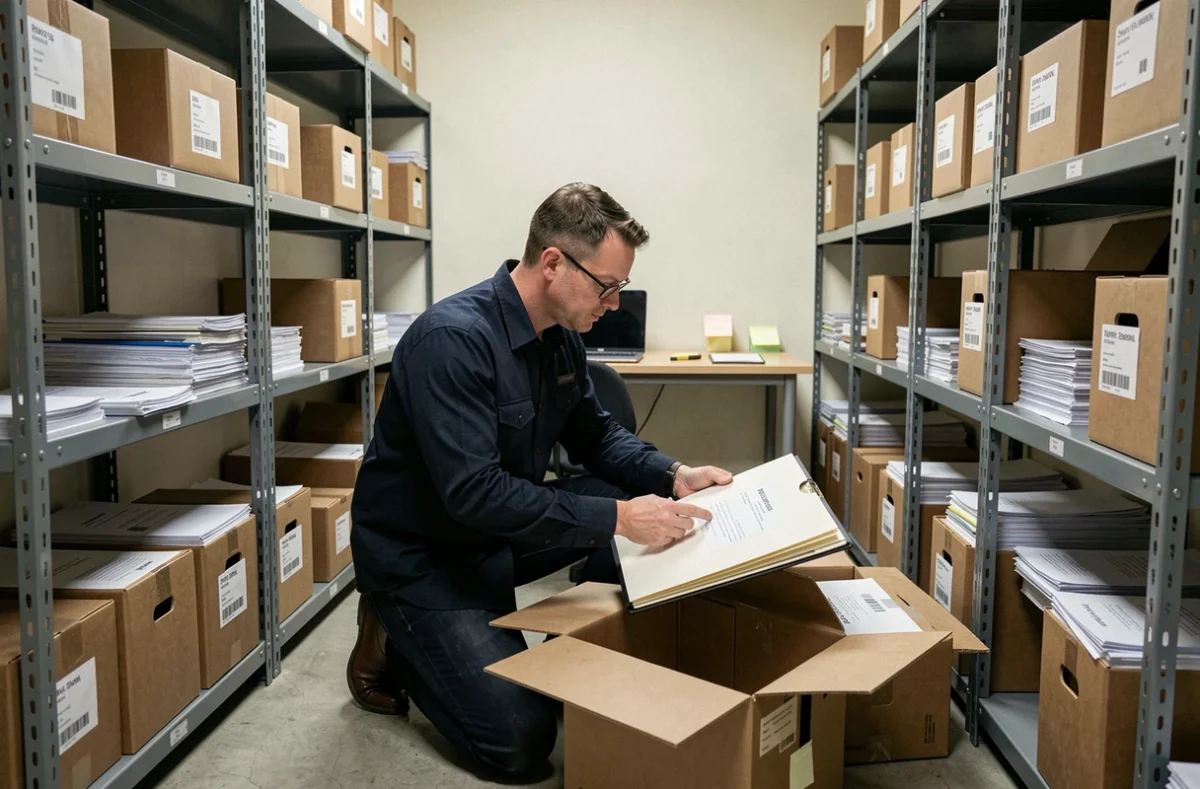
- Intermediate archiving: the document is no longer regularly consulted, but a legal obligation or potential litigation justifies its retention. Access is restricted to a few authorized individuals.
- Deletion or anonymization: once the retention period has expired, the data must be purged. Not simply moved to a subfolder, but effectively deleted, including in copies, exports, and attachments.
This last point poses a concrete problem. Copies multiply: an HR file sent by email, duplicated on a shared cloud, downloaded to a local workstation. The purge must cover all of these replicas. As long as a single copy remains, the obligation is not fulfilled.
Backup and Archiving: Two Distinct Logics Against Disasters
Confusing backup and archiving is the most common mistake. A backup protects against accidental loss: disk failure, accidental deletion. Archiving guarantees long-term access and probative value for the required legal duration.
In the face of ransomware, recent recommendations suggest having multiple copies, at least one isolated from the network. The idea is simple: if malicious software encrypts all connected files, a disconnected copy remains intact. Another copy, stored at a physically distinct site, covers the risk of fire or water damage.

For personal archives (family photos, notarial acts, diplomas), this approach translates into an accessible action: keeping a copy on an external drive stored outside the home, at a relative’s for example, in addition to the main storage. For a business, the strategy involves dedicated media and a regular verification schedule.
Check Your Backups, Not Just Create Them
A backup that is never tested is a backup that does not exist. Opening an archived file every few months allows you to detect silent corruption before it’s too late. This reflex applies equally to individuals and SMEs.
Concrete Classification Plan for Mixed Paper and Digital Archives
A classification plan relies on a stable hierarchy. Why stable? Because a system that changes logic every six months creates gray areas where documents become untraceable.
The principle of respecting fonds, inherited from archival science, provides a useful reference even on a small scale. It consists of grouping documents according to their production context, not according to an arbitrary theme. Invoices from a supplier remain with that supplier’s file, not in a generic “invoices” directory.
For a mixed paper-digital classification, coherence comes through a correspondence table. A simple file that associates each physical box with its digital equivalent. The “inventory” column identifies the broad category (accounting, HR, legal, clients), the “typology” column specifies the nature of the document (contract, pay slip, quote), and a possible “retention period” column reminds of the purge deadline.
An effective classification is judged by the speed of search, not by the aesthetics of labels. If finding a document takes more than two minutes, the system deserves to be reviewed.
Destruction of Archives: When and How to Proceed
Destroying a document is not a trivial act. For paper archives containing sensitive data (pay slips, medical records, legal correspondence), shredding into fine particles remains the safest method. Throwing whole sheets into a recycling bin exposes you to a data leak.
On the digital side, deleting a file does not erase it from the disk until the space is rewritten. Specialized tools allow for secure deletion. For end-of-life media (USB drives, hard disks), physical destruction is still recommended.
Planning destruction in the archive management calendar avoids two pitfalls: keeping data too long that exposes the organization to GDPR risk, or destroying a document too early that is still necessary in case of audit or litigation. The correspondence table mentioned above, supplemented by the legal durations specific to each type of document, serves as a safeguard on a daily basis.