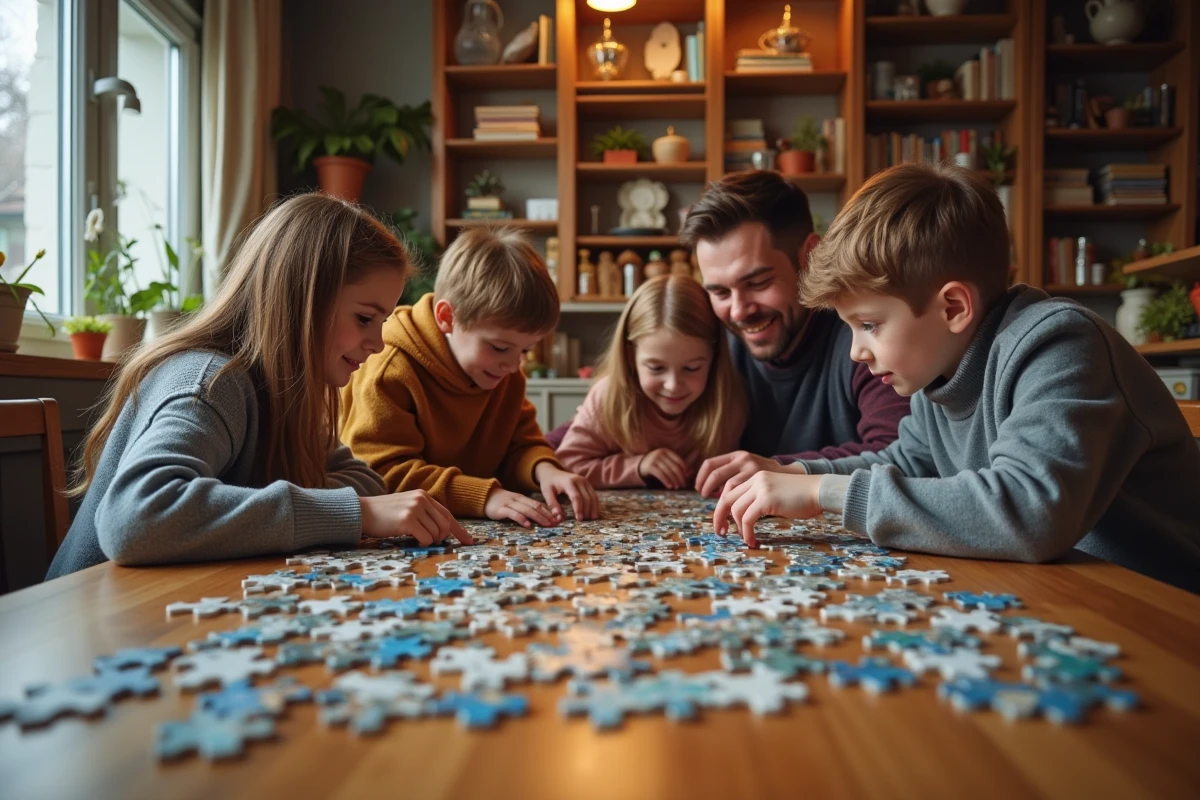
A Guinness world record requires that each puzzle piece be unique, excluding any repetition of shape, no matter how small. A little-known rule forces manufacturers to constantly innovate to meet these strict requirements.
Some international competitions prohibit the use of any sorting method before the timer starts, disrupting the usual strategies of champions. In this context, Sophie, holder of three world titles, stands out for her unmatched mastery of advanced techniques and her deep knowledge of puzzle categories, from classic to oversized creations.
Sophie, three-time world champion: a portrait of an extraordinary enthusiast
In the microcosm of puzzle masters, Sophie embodies rigor and boldness. A three-time world champion, she does not limit herself to assembling: she dissects, anticipates, and outsmarts the traps set by manufacturers. Her practice goes far beyond a simple hobby; each session transforms into an exercise in precision, where every segment, nuance, and pattern matters. Few in France can rival her journey, which commands admiration on all international circuits.
The pieces glide through her fingers with an almost magnetic ease. Other stars, like Deepika Ravichandran, famous for completing a 1,000-piece puzzle in 1h01m29s, or Sarah Mills, winner of the 2020 British Championship with a time of 1h40, share this obsession with detail and tempo. But Sophie enjoys both solo challenges and team competitions: the performance of the Siberian team, assembling 5,000 pieces in 4 hours, motivates her just as much as duels against herself.
Her passion is also expressed in an international community where collector Khloud Abo Zayda, with her 1,260 puzzles in Saint Paul, Minnesota, illustrates another facet: that of memory, accumulation, and a board game in perpetual evolution. The shared feats during the 2019 World Championship in Valladolid, such as the 500 pieces in 34 minutes and 34 seconds by Demelza Becerra Robledillo and Ángel Heras Salcedo, testify to this collective emulation.
To learn more about the largest puzzle, the dedicated file on record assembly pushes the limits between human challenge and collective achievement. In this nebula of enthusiasts, Sophie remains, for many, a guiding figure. She embodies everything that the puzzle has of the most demanding, between rigor, creativity, and the quest for surpassing oneself.
Secrets of giant puzzles: categories, records, and unexpected challenges
The world of giant puzzles far exceeds the realm of family entertainment. The numbers set the tone: the largest puzzle in the world ever assembled boasts 551,232 pieces. In Ho Chi Minh City, on September 24, 2011, 1,600 students joined forces to assemble a gigantic lotus over 345 m². This project, divided into 3,132 sections of 176 pieces, was completed in 17 hours, under the supervision of Guinness World Records.
Enthusiasts also identify the 54,000-piece commercially available puzzle, launched by Grafika in 2020, as a must-have reference. This colossus named “Around the World” measures 864 cm by 204 cm, weighs nearly 30 kg, and requires 400 to 600 hours of assembly. Delivered in independent sections, it transforms the experience into a true mental and physical marathon.
For those who love to push boundaries, several formats stand out. Here are some examples of extraordinary puzzles that fascinate collectors:
- The “Travel Around the World,” 48,000 pieces, featuring 29 illustrated countries, packaged in a 28 kg suitcase.
- The handcrafted puzzle of 101,010 pieces created by Jill Walterbach.
- “The Hardest Puzzle in the World”: 529 entirely white pieces, with no visual reference.
- A 467-piece puzzle depicting a golden retriever and her puppies, sold for $27,000 at auction in Pennsylvania.
The diversity of formats and categories enriches the history of the puzzle. Each record, each rare model, enhances the passion of those who collect, who seek achievement, or simply who want to embark on an extraordinary collective challenge.
From yesterday’s puzzle to champion techniques: how the puzzle conquered the world
Long before becoming a social phenomenon, the puzzle was merely an educational game designed to teach geography. In 1766, British cartographer John Spilsbury invented the concept by cutting a map into wooden pieces. Quickly, the European aristocracy adopted this new object. From Paris to Berlin, specialized shops flourished, and the puzzle found its place in salons, oscillating between distraction and educational tool.
Gradually, the collective practice organized itself. In Barcelona in 2012, nearly 9,600 people gathered around the same puzzle, affirming the unifying dimension of this activity. The enthusiasm spread across Europe: in France, Germany, Italy, as well as in Portugal, Belgium, and the Netherlands, the puzzle became ubiquitous, from schools to universities.
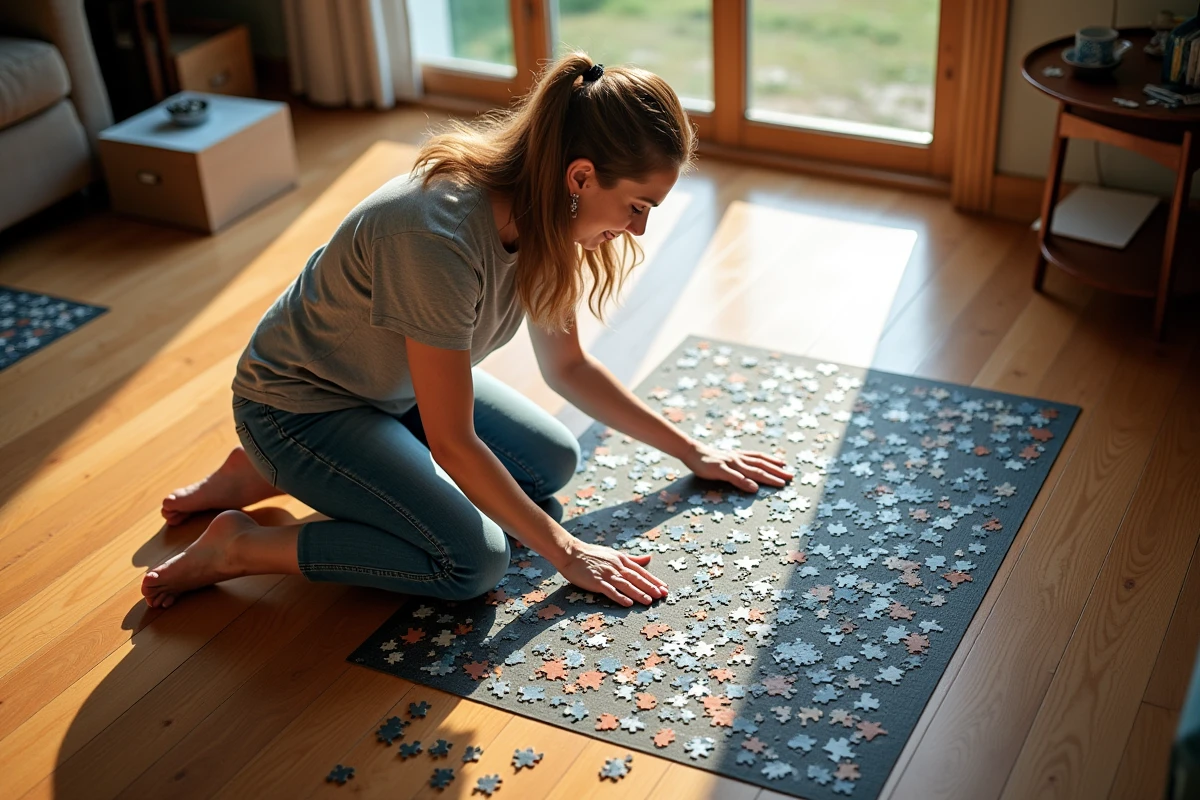
The championships have multiplied, and with them, assembly techniques have become true rituals: meticulous sorting of colors, edge construction, methodical work by zones, time management down to the second. The puzzle has established itself as a cerebral sport, demanding an overview, precision, and endurance. A field where amateurs and experts meet, all driven by the same thirst for excellence and the taste for shared or solitary challenges.
Assembling thousands of pieces, breaking a record, or simply losing oneself in the construction of an image is to choose, each time, to push one’s own boundaries. The puzzle, far from being a mere pastime, continues to unite, fascinate, and bring together, piece by piece, challenge by challenge.